
News & Highlights
Recent research, awards and alumni news from the Department of Life and Environmental Sciences.
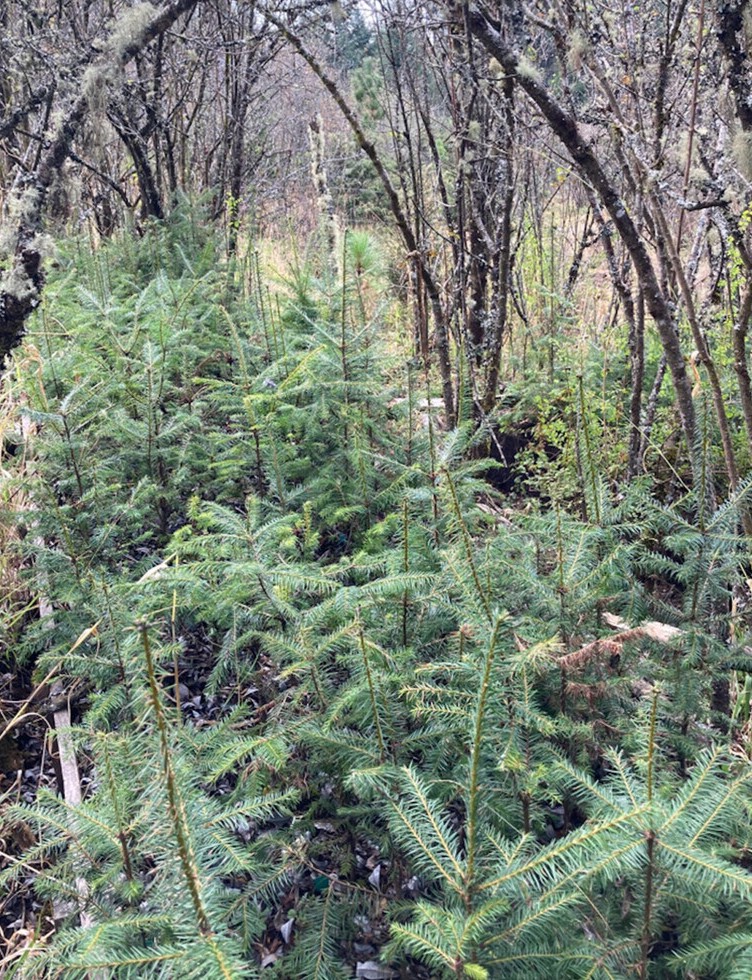
New Research Examines How Sacred Fir Trees Respond to Heat and Drought
LES Professor Emily Moran, alongside former Ph.D. student Yinyue Du, has published research investigating how sacred fir (Abies religiosa) trees respond to heat and drought stress.
The study builds on a common garden experiment conducted by Dr. Cuauhtémoc Sáenz-Romero at the Universidad Michoacana de San Nicolás de Hidalgo in Morelia, Mexico. Sacred fir is an ecologically important species that provides critical overwintering habitat for monarch butterflies.
Researchers observed that while seedling survival was considerably lower in the warmest and driest garden, some surviving trees remained healthy, including individuals originating from higher-elevation environments. Through genetic analysis, Du identified genetic variations potentially associated with selection under low-elevation heat and drought conditions, offering insight into how this important species may respond to changing environmental conditions.
The research highlights the potential for genetic adaptation to influence the resilience of sacred fir populations in a changing climate.
LES Faculty Recognized with School of Natural Sciences Awards
Congratulations to LES faculty members Carolin Frank and Sylvain Masclin, who have been recognized with School of Natural Sciences (SNS) awards celebrating their outstanding contributions to academic program development and undergraduate education.
Carolin Frank
Professor Carolin Frank received the Developing New and/or Improving Academic Programs and Tracks Award in recognition of her leadership in establishing the new Life and Environmental Sciences graduate program. Following a multi-year development process, the M.S. and Ph.D. programs received approval from the UC-wide Graduate Council in January 2026, with the inaugural cohort anticipated in Fall 2027. This achievement establishes a new academic home for interdisciplinary graduate education at UC Merced.
Sylvain Masclin
Professor Sylvain Masclin received the Innovations in Undergraduate Education Award for his innovative approach to teaching and student engagement. His work includes developing AI-powered course tutoring tools, interactive learning activities, and resources that help students strengthen their understanding of course material. He has also supported faculty development through teaching resources, workshops, and campus-wide conversations about the role of artificial intelligence in higher education.
These awards recognize the dedication, innovation, and leadership of LES faculty in advancing educational opportunities and strengthening the student experience at UC Merced.
Congratulations to both faculty members on this well-deserved recognition!
LES Research Contributes to California’s Fifth Climate Change Assessment
LES faculty member Marilia Palumbo and her research team contributed to California’s Fifth Climate Change Assessment, a statewide effort examining the impacts of climate change across California.
The team’s work focused on understanding how climate change affects pollination services in California, an essential ecological process that supports biodiversity, ecosystem health, and agricultural production.
Their contribution helps advance understanding of the connections between climate change and ecological systems, highlighting the importance of research in informing conservation efforts and climate resilience strategies.
Explore California’s Fifth Climate Change Assessment to learn more about the statewide research and findings.
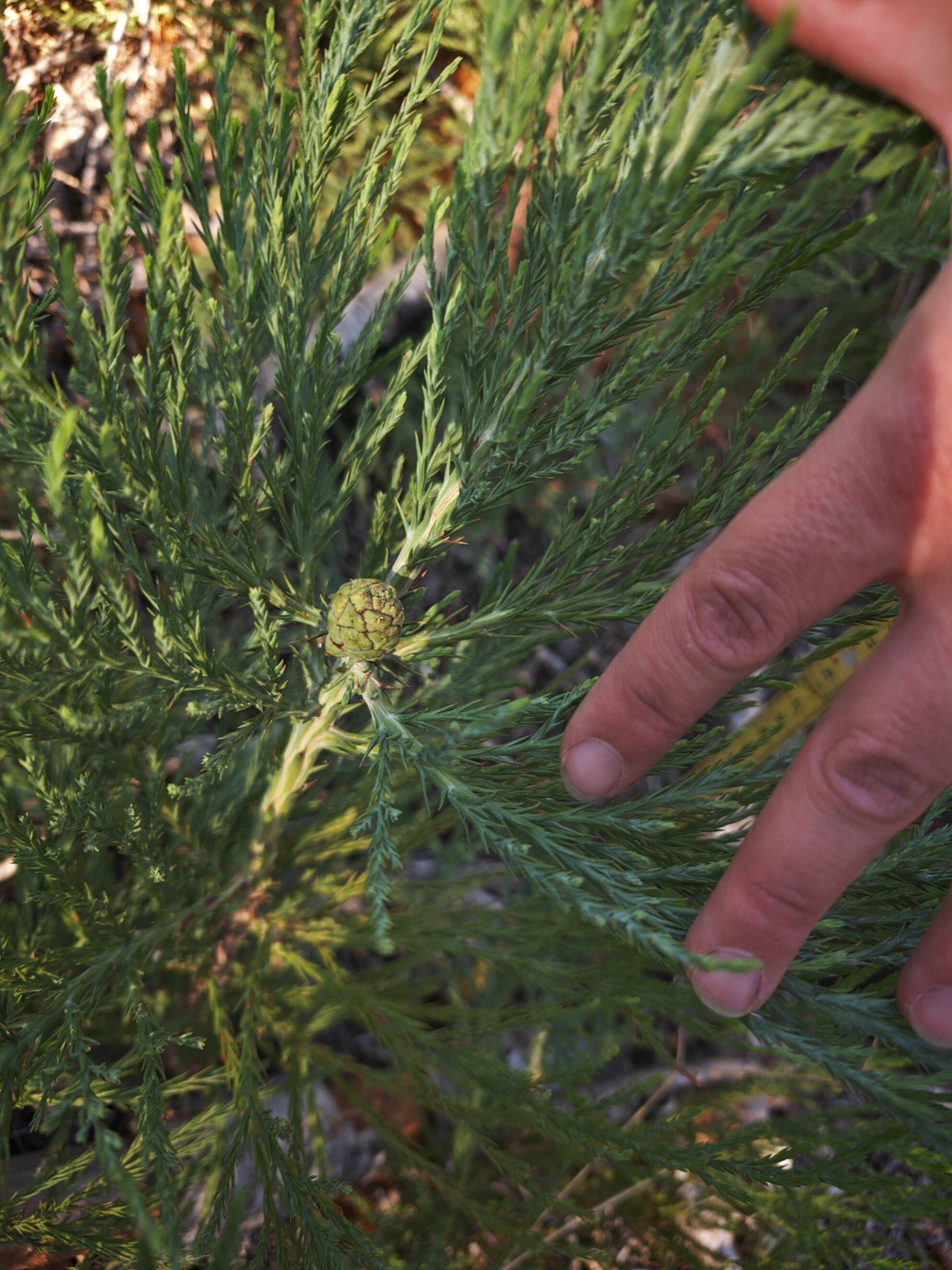
A Surprising Discovery: Young Giant Sequoias Are Producing Cones Earlier Than Expected
LES Professor Emily Moran and postdoctoral researcher Diane Huebner recently documented an unexpected discovery involving giant sequoias: trees much younger and smaller than typically expected are producing cones.
The observation began when the researchers discovered a three-year-old giant sequoia seedling, less than one meter tall, that had already produced a cone. Because giant sequoias generally need to reach a much larger size before becoming reproductively mature, this finding prompted further investigation and was published as a natural history observation in Ecology and Evolution.
This summer, Moran observed numerous additional young giant sequoias producing cones in the Sierra National Forest. The trees, planted in 2016 as part of a post-drought and beetle-mortality restoration effort, were only about 10 years old.
Interested in understanding this phenomenon further, Moran submitted a pre-proposal to the Save the Redwoods League and has now been invited to submit a full research proposal.
If funded, the project would involve undergraduate researchers in surveying young sequoias, testing seed viability, and investigating whether naturally regenerating trees following wildfires are also producing cones at unexpectedly young ages.
This research could offer new insights into giant sequoia reproduction, forest regeneration, and the future of these iconic trees.
Living on the Edge: Why Bigger Mammals Carry More Fat
Why does an elephant carry proportionally more body fat than a mouse? A new study led by LES Associate Professor Justin Yeakel offers an ecological explanation for this long-standing scientific question.
Published in The American Naturalist, the research explores how food availability and foraging behavior influence patterns of fat storage across mammals, from tiny shrews to enormous blue whales.
The research team combined mammal fat data with historical whale estimates drawn from whaling logbooks dating back to 1784–1920. They then developed a mathematical model to investigate how animals of different sizes respond to changes in food availability.
Their findings suggest that when food is scarce, larger animals can gain energy more efficiently through larger food intake and longer foraging periods. This advantage helps explain why larger mammals tend to carry proportionally more fat.
The study also suggests that wild mammal populations may operate close to the limits of their available food resources, making patterns of body fat an indicator of ecological scarcity.
The publication highlights the collaborative research contributions of UC Merced faculty and students, including recent graduate Mason Fan, who helped develop the dataset, conduct analyses, and interpret the findings as an undergraduate researcher.
Additional UC Merced coauthors include Professors Emily Jane McTavish and Sora Kim, along with Ph.D. student Anna Carolina de Almeida.
The project was supported by the National Science Foundation, with additional support from the Santa Fe Institute.
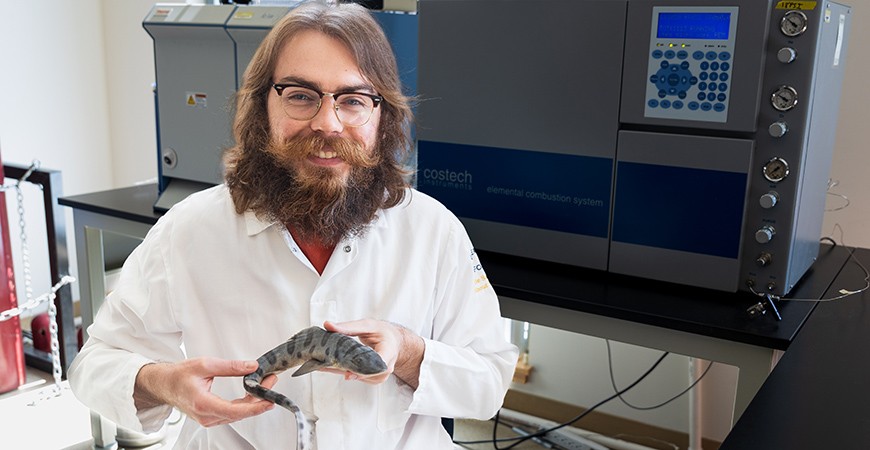
From UC Merced to Hong Kong: Dr. Jonathon Kuntz Begins New Research Appointment
Congratulations to Dr. Jonathon Kuntz, a 2025 graduate of the Quantitative and Systems Biology (QSB) Ph.D. program, on his new professional appointment!
Following the completion of a one-year Sea Grant State Fellowship with the Alaska Department of Fish and Game, Dr. Kuntz has moved to Hong Kong, where he is now an Integrative Marine Ecology and Conservation Postdoctoral Fellow at the Swire Institute of Marine Science (SWIMS), University of Hong Kong.
His new position marks an exciting next step in his career and continued contributions to marine ecology and conservation research.
Congratulations, Dr. Kuntz! The LES community wishes you continued success in this next chapter.
Follow along on Instagram: @jkfordays · @swims_hku · @hkuniversity
Send LES research, awards and alumni updates to the department so we can feature them here.
